Tuesday, May 4, 2010

Redefining Perfection

"When you aim for perfection, you discover it's a moving target." ~ Geoffrey F. Fisher

Last night, while I was on the phone with my mother-in-law, our conversation led to a discussion on the concept of perfection.

According to the Merriam-Webster’s dictionary the following are two definitions for perfection: 1) the quality or state of being perfect: as a: freedom from fault or defect : b: the quality or state of being saintly; 2) a: an exemplification of supreme excellence b: an unsurpassable degree of accuracy or excellence.

Nice definitions, but if we look at them closely, they are not definitions of perfection per se, but definitions built around individual perceptions of it.

1a- "Freedom from fault or defect – what exactly does that mean? Who is perfect enough to decide what is faulty or defective? Our perception spins from what we have been taught, and it rarely reflects reality; it merely shows what we consider right or wrong in base of what we have learned. Even when we are sure to be "thinking with our own head," our perception of the world around us is filtered through our senses, which are limited and faulty at best.

1b- "The quality or state of being saintly" – What constitutes a saint? Is it someone who spends their life doing for others? Most likely it is someone who’s considered good when measured against our societal scales, which are created by men and are not perfect.

2a- "An exemplification of supreme excellence" – The only supreme excellence is that of a higher intelligence – no man, or anything created by man, can perceive the full concept of it. It equates fitting the waters of an ocean inside a bottle – only a tiny part of it can go in.

2b- "an unsurpassable degree of accuracy or excellence." – Big words, but again, who decides what is accurate and excellent? What parameters do we use to decide if something is completely correct?

Although amazing milestones have been conquered, even science is not perfect, and it is baffled by Nature quite consistently. Just like a virus, perfection cannot be isolated – it mutates and assumes different identities depending on what trends it contends with, and the perception of it changes from individual to individual. That explains why some people can see something or someone and think they are perfect and wonderful, while some others can look at the same and see only faults and defects.

This distinction applies to many concepts – good and evil, beauty and/or lack of it, religion, politics; the list could be endless. Our perception is largely affected by our environment and the rules we have grown to identify with. There is no such thing as a perfect human or a perfect thing – the sooner we realize this simple reality, the closer we will be to understanding that being unique is perfect in itself.


http://www.sandracarringtonsmith.com

Monday, May 3, 2010

Book Signing

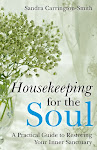
This month my first two literary children are going to be born. Though I often joke around about giving birth to twins, the two couldn’t be any more different in nature. The first one, Housekeeping for the Soul, a nonfiction guide to self-renewal, is written in the same voice as my blog posts, while the second one, The Book of Obeah, is a novel of paranormal suspense.

Since many of you have been following this journey from the start and have asked to be notified when the ‘big day’ would finally come, I am happy and proud to announce (seriously, I am floating about an inch over the floor even as I write this) the official birth of the first twin, Housekeeping for the Soul.

The sweet bundle of joy is due to see the light of the world next Saturday, May 8 between 1:00 pm and 3:00 pm at the Barnes & Noble at The Streets at Southpoint in Durham, NC.

Though it is not officially released, I just found out this morning that the second twin, The Book of Obeah, is already stocked at the warehouse as well. It is probably not going to be on the shelves yet, but if you are coming, and you are interested in getting a copy ahead of the official release date, please do call the store a few days prior to the event, and they will have it there waiting for you when you arrive.

Thank you so much for your ongoing support, everybody, and I hope to see many of you next Saturday afternoon.

Blessings,

Sandra


www.sandracarringtonsmith.com

Sunday, May 2, 2010

School for the Soul

"God allows us to experience the low points in life in order to teach us lessons we would not learn in any other way. The way we learn these lessons is not to deny the feelings but to find the meanings underlying them." ~ Stanley Lindquist


To the joy of most children on a traditional school calendar, the 2009-2010 scholastic year is, once again, drawing to an end. In five and a half more weeks, according to one of my sons, ‘jail will let out.’ That mere comment, happily uttered while standing in front of the calendar counting remaining ‘jail’ days, made me smile.

I asked Michael what he meant by ‘jail life’ at school, and he looked at me with a wide-open, deer-in-the-headlights expression on his face; to his child-mind I had asked the unthinkable. "Why Mom," he said speaking a tad slower as one would do in front of a mentally challenged audience, "I know school is important, but you can’t do anything fun there. And, most of the time, even if teachers get things wrong, you can’t even speak up to say what’s really happening, because that’s considered talking back. And last but not least, there is all this work we always have to do! There just isn’t any time left for being a kid."

I thought for a moment about Michael’s description, and I asked him: "If your teachers didn’t have expectations, and no work was required, if you were never allowed to fail anything or run into conflicts with other kids, school would be more fun, but would you learn anything?"

Michael became silent for a moment, then he looked at me and raised his eyebrow. "Well, I guess not too much. It’s great to have fun all the time, but it doesn’t teach you much, does it?" I gloated inside, careful not to show him how satisfied I was that I had finally won an argument against the teenage genius mind, and I simply smiled at him as he walked away from the calendar and back toward the stairs to go up to his room. This exchange led me to think about life in general, and how wonderful it would be if all could be roses; but if everything was always simple, work and hardship were never an issue, and conflict didn’t exist, would we really learn anything about ourselves and others?

Hardship is often the quickest pathway to learning of our own strengths and weaknesses, and the best gauge to measure our resilience. It is through struggle that we discover we can go the extra mile, and through a bruised ego that we understand what matters most.

While listening to a memorial service a few nights ago, one of the most important things I left with was that our spirit wasn’t born with our body – it is timeless, birthless, deathless, and only using the physical body to learn from our experiences in this world. A life with no challenging experiences would be like a classroom without teachers and curriculums; it would be a fun ride, but in the end we would walk away with nothing learned and little to tell.

A day in school allows children to put in several hours of work and structure, and still gives them a bit of time for recreation and social contact; their time is used to learn and become functional individuals. Life is no different: we are born, learn from other teachers, get punished if we do wrong and rewarded if we do well, and all throughout we enjoy bits of recreational time to relieve the pressure of the challenges leading to our learning. Happy, prosperous and easy-going spells are our well-deserved summer breaks. It might take us a little longer to graduate, but the benefits of our experiences will reach all the way to the soul.